
Escambia Work Annex Release Paths
The Escambia County Work Annex is a county detention site in Cantonment. It is not a Florida Department of Corrections prison. People housed there remain within the local Escambia booking system. Their next event can be a final discharge to the community, a court-directed release, movement to the Correctional Facility, placement with an overflow custodian, commitment to FDC, or transfer to a federal or immigration authority.
The key is the event, not the unit label. A record that changes from Work Annex to Main Jail may show a routine movement within the county system. The same is true when a court appearance or operational need changes the physical location. A community release requires the matched booking’s Released status and timestamp, plus a check for any hold or receiving agency. When a release is tied to supervision, the jail event proves physical departure but not the end of the court or supervision order.
Confirm Escambia Work Annex Releases
Escambia uses one countywide JAIL View release search for Work Annex and Main Jail bookings. Select “Released Inmates Only.” The current-inmate setting is designed for people still held, while the released setting reveals begin and end release-date fields. A no-result in the current view can mean release, transfer, a name mismatch, or a date problem. It cannot settle the question alone.
- Search the surname and first name in released-only mode. Use a broad date span when the exact exit date is unknown.
- Match the photo, age, booking number, MNI number, booking time, agency, and court case rather than relying on the name alone.
- Read the exact Released timestamp under that booking. Do not use the page’s default booking count as a release count.
- Inspect holds and agency text for DOC, ICE, federal, or another-county custody.
- If the unit or destination remains uncertain, request the movement history and release sheet from County Corrections.
A bond value is not a release method. It may remain on the booking after a judge changes terms, credits time served, orders pretrial release, or sends the person to another authority. The court docket can explain the legal order, while the jail’s exit record establishes the physical event. For a broader source sequence, use the Escambia County released-inmate records overview.
Escambia Work Annex Records Contact
The county publishes a direct Work Annex address, telephone number, and email. Operational questions about the Annex can start there. Requests for a booking-and-release sheet, movement history, release authorization, receiving agency, or booking image belong with Escambia County’s public-record custodian and Corrections. Since county government operates detention, those jail records should not be routed automatically to the Sheriff’s Office.
Escambia County Work Annex
601 Highway 297-A
Cantonment, FL 32533
850-937-2100
workannex@myescambia.com
A useful request names the person, booking number, and booking date. Ask for the actual release date and time, the release type or reason, movement between county detention sites, and the receiving agency when transferred. Electronic copies and an advance cost estimate keep the scope clear. The county records-request page routes requests to the proper custodian. A court judgment or certified disposition still comes from the Clerk.
Note: The Work Annex contact can address current operations, while the county records custodian handles formal release-record production.
Escambia Work Annex Release Programs
Escambia County describes the Work Annex as Florida’s only county-operated work camp. Its official program list includes welding certification, GED work, life-skills and parenting classes, “40 Days of Purpose,” Alcoholics Anonymous, farming, hydroponics, and aquaculture. Those details identify the facility’s local role. They do not make it a state work camp or convert participation into proof of release.
The official Work Annex page documents the facility identity and its published programs.
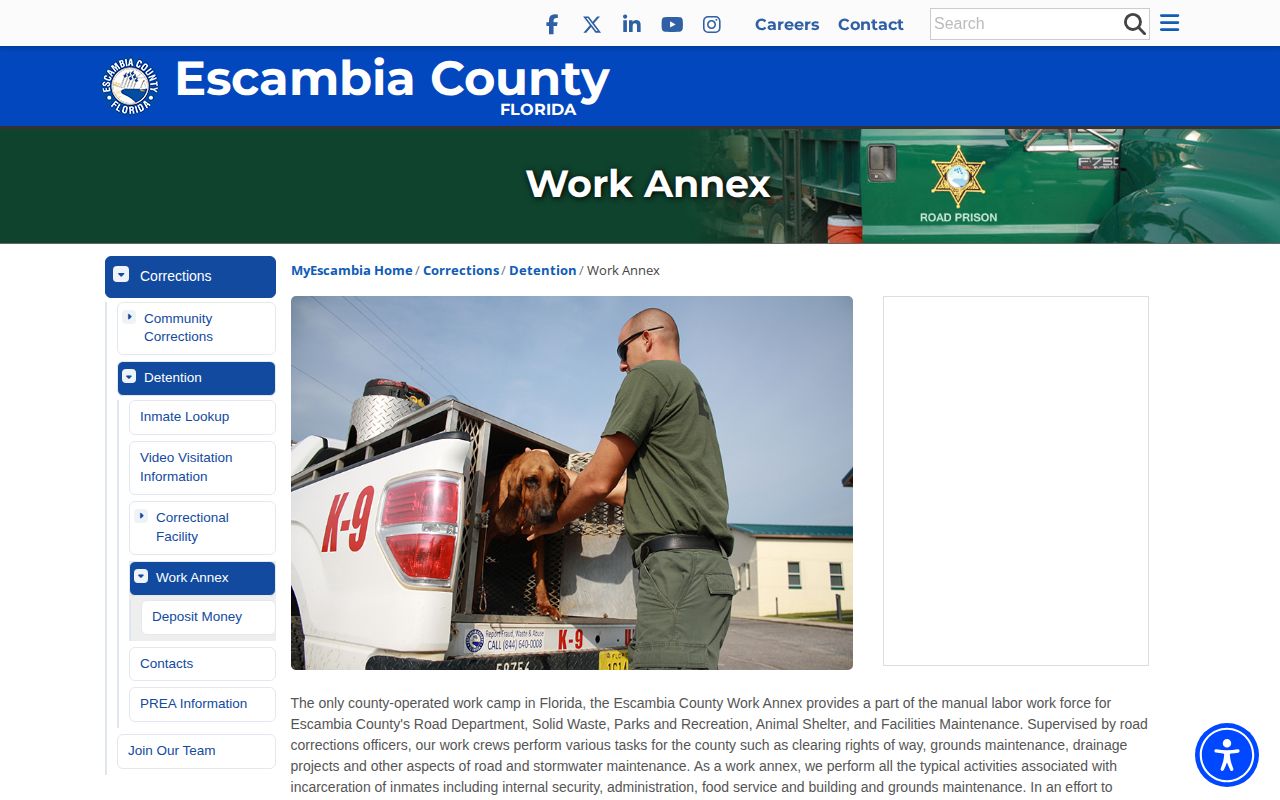
The captured county page supports the Work Annex’s county-operated status. Release confirmation still comes from the booking event, not completion of a class or work assignment.
Program participation may help with transition, but current intake, completion, and eligibility should be confirmed with the facility. The research also identifies Re-Entry Alliance Pensacola and Pathways for Change as local navigation sources. Neither program should be treated as the destination for every person who leaves the Annex. A release record can show when county custody ended; it usually will not promise which community program a person later uses.
Escambia Annex Moves Versus Releases
A movement record and a release record answer different questions. A movement record follows a person among detention units or physical custodians. A release record marks the end of the booking’s control by the releasing custodian. Escambia can also hold people outside the county, including in Walton County arrangements identified by the county. A person may retain an Escambia booking while another jail provides the bed.
| Observed event | What it supports | Next source |
|---|---|---|
| Work Annex to Main Jail | Internal county movement, not final discharge | Escambia Corrections movement history |
| Released status with no hold | Departure from the booking | Release sheet and court docket |
| DOC or federal notation | Possible transfer to another sovereign | FDC or BOP locator |
| Other-county custodian | Physical custody may continue elsewhere | Escambia plus receiving jail |
Use the exact timestamp to order the sources. A receiving-system entry after the Escambia exit is strong evidence of transfer. If the person has no receiving entry, do not guess. Request the destination from the office that made the movement.
Escambia Annex Release Transfer Checks
Escambia’s 2025 agreement with ICE supports warrant-service activity around the end of criminal custody. Local JAIL View records can carry ICE holds. If one appears on a Work Annex booking, the county release may be a handoff to immigration custody. Ask Corrections for the detainer disposition, receiving agency, and destination before calling the person free in the community.
ICE’s locator covers eligible current detainees and a limited recent-release period. It is not a permanent release archive. No match can result from a timing delay, a disclosure limit, a name or identifier issue, or an event outside locator coverage. County records and an authorized ICE inquiry may be needed. A DOC hold should instead be followed into FDC’s inmate population and release searches, because FDC custody is separate from the county Work Annex.
- Custody move
- A change in where the person is held within the same booking.
- Detainer
- A request or notice that another authority may take custody.
- Final discharge
- The point when the releasing custodian ends control without a transfer under that record.
Escambia Work Annex Record Names
Escambia’s detention history creates name conflicts in older records. After the 2014 flood, gas leak, and explosion condemned Central Booking, county custody was spread across the Main Jail, Work Release Center, Walton County, and Santa Rosa County. The present Correctional Facility opened in 2021. Archived documents can refer to Central Booking, CBDF, L Street, Main Jail, Phase I, or Phase II.
The Work Annex’s current address remains separately published in the county contact directory. Even so, an old unit label should be treated as a search clue, not conclusive proof of the place of discharge. Match the booking date, number, and release event. Current contact information should come from the present county directory. That approach keeps an archived facility name from being mistaken for a current release location.
Escambia reports more than 15,000 booking and release transactions each year across a system responsible for more than 1,300 people, including overflow arrangements. That volume is not a count of unique Work Annex discharges. Transfers and repeat bookings are included in county operations. Use the individual booking and its exact event history. A program or unit name can identify where part of custody occurred, but only the release timestamp and receiving-agency information establish how that custody ended.
No official source in the research gives a fixed Work Annex release hour, exit door, or weekend processing schedule. The direct facility line is the correct place to ask about current logistics, using the booking number when available. A projected time can change while staff complete the court order, record checks, account closeout, property return, or a hold review. Treat the release as complete only after the county record posts the event or Corrections confirms it.
Note: An older facility label can describe where the booking was managed, not the site where final release occurred.
Public Record Search
Sponsored Results