
Video Center Release Boundary
The Video Visitation Center is a county public-service site. It is not a jail, work camp, state prison, holding unit, or release-processing facility. It does not house people in custody. Therefore, it cannot create a physical release event or issue a release record for someone leaving its custody. Any wording that says a person was “released from” this center is inaccurate.
The center appears in the Escambia corrections context because it supports public access to a detention service. That association can make an official Pace Boulevard contact look like a separate jail. The correct question is which institution actually held the person. For most local adult bookings, that will be Escambia County Correctional Facility, the Work Annex, or an outside jail used for overflow. State, federal, juvenile, and immigration custody have separate systems.
Route Video Center Release Questions
Start with the name, date of birth, expected booking date, and any known booking or court number. Then classify custody. A county arrest does not prove the person stayed at the place named on a visitation notice. Escambia books people from several agencies and can place them at more than one detention site. A video-visitation appointment or account only points to a service, not to a discharge location.
| Actual custody | Release source | What the result means |
|---|---|---|
| Escambia county booking | JAIL View and Corrections release sheet | Local exit time and possible destination |
| Florida state prison | FDC Inmate Release Information | State release or scheduled-release record |
| Federal prison | BOP Inmate Locator | End of BOP custody, subject to stated limits |
| Immigration custody | ICE locator and authorized inquiry | Eligible current or short-window information |
If the custodian is unknown, begin with the local booking and court case. Holds and agency labels can identify the next system. The Escambia County released-inmate search path provides the county, state, federal, and court sequence without treating the Video Visitation Center as a jail.
Confirm Escambia Jail Releases
Official Escambia JAIL View is the first source for an adult county booking. Choose “Released Inmates Only.” A current-inmate search is not enough because a person who has left local custody may no longer appear there. The default “BOOKED Last 24 Hours” display also counts bookings, not releases.
- Enter the person’s surname and first name. Use release dates when known, but remove narrow dates if the search fails.
- Match the photograph, age, booking number, MNI number, agency, and case number.
- Read the exact Released date and time shown under the same booking.
- Inspect holds and charge-agency details for DOC, ICE, another county, or federal custody.
- Request the release sheet and receiving agency when the public booking does not explain the exit.
A Released status proves the end of that local booking’s physical custody. It does not prove that every court order ended or that the person returned to the community. A move to the Work Annex or Main Jail is an internal movement. A handoff to FDC, another jail, BOP, or ICE is a transfer. The actual custodian’s system must confirm what happened next.
Note: A video-visitation record can show service access, but it does not prove custody status, transfer, or release.
Video Center Records Contact
Release questions should go to Escambia County Corrections Detention, not to a presumed Video Visitation Center release desk. The Detention Division can route questions about the local booking and current facility contacts. Formal requests for a booking-and-release sheet, movement history, release authorization, or receiving agency go through the county public-record process.
Escambia County Corrections Detention
3080 N. Pace Boulevard
Pensacola, FL 32505
850-436-9830
jaildetention@myescambia.com
The shared Pace Boulevard context is precisely why the names can be confused. The address above is the published Detention contact and current Correctional Facility address. It should not be used to claim that the Video Visitation Center is another detention unit. Ask for the actual facility tied to the booking, then direct the records request to that custodian. A certified judgment or release order comes from the Clerk, not a visitation service.
The current detention contact directory identifies the county’s verified detention contacts.
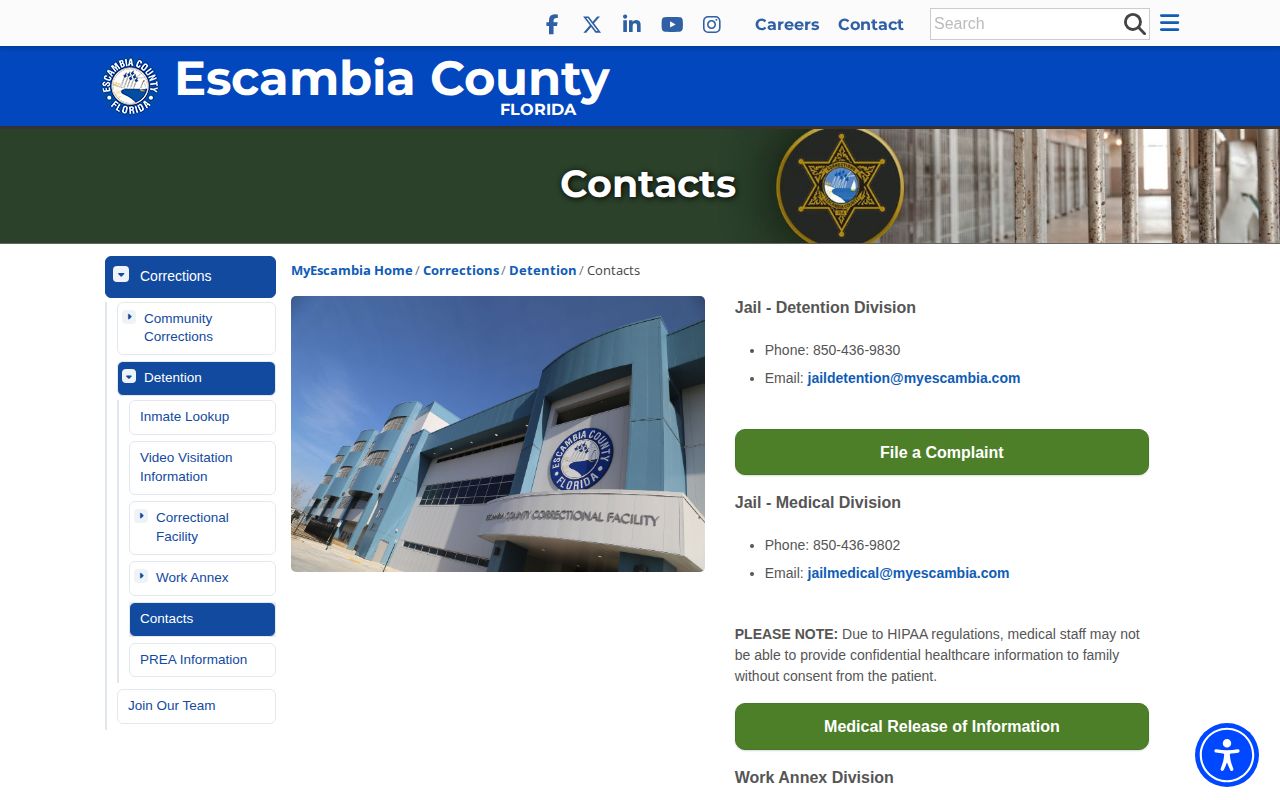
The captured directory supports routing to Detention and named custodial facilities rather than inventing a release function for the Video Visitation Center.
Video Center Custody Record Routing
Escambia’s records are split by creator. The Board of County Commissioners assumed jail operations from the Sheriff’s Office in 2013. County Corrections therefore holds modern jail-operation and release records. ECSO may hold an arrest report made by its deputy. The Clerk holds the court docket, judgment, sentence, and certified disposition. Sending all questions to the sheriff can miss the county record that actually proves the exit.
A narrow county request should identify the full name, booking number, booking date, actual release time, release reason or authorization, movement history, and receiving agency. Ask for electronic copies and a cost estimate. If some content is exempt, the custodian can redact it and provide the public remainder. Florida law requires a good-faith response but does not promise one fixed response time for every request.
- Custodian
- The public office responsible for the requested record.
- Release sheet
- The jail record that can document the exit event and release authority.
- Disposition
- The court’s recorded outcome for a charge or case, which is different from the jail exit time.
These records answer related but separate questions. The release sheet tells when county control ended. The court file explains the legal case. A receiving-system record shows whether another custodian took control.
Escambia Video Center Transfer Records
Escambia JAIL View can show holds from DOC, ICE, another county, or other authorities. A 2025 agreement between Escambia County and ICE adds a documented local transfer layer near the end of criminal custody. If a matched booking includes an ICE hold, request the detainer disposition, receiving agency, and destination. The county release should not be described as community freedom until that transfer question is resolved.
Use FDC’s public systems after a state commitment. Its population record shows state custody, while its dedicated release search covers people released or scheduled for release from state prison. Use BOP for a federal term. BOP warns that “Released” or “Not in BOP Custody” only ends BOP custody and does not rule out another justice system or supervised release. ICE’s public locator has limited eligibility and a short recent-release scope, so it is not a permanent archive.
None of these transfers occurs from the Video Visitation Center. They occur from the jail or agency holding the person. The visitation center remains only a service contact in this analysis. Keeping that line clear prevents a public address from being mistaken for the source of a custody event.
Note: Follow a hold into the receiving agency’s system; never substitute a visitation-service name for the actual releasing custodian.
Escambia Facility Names and Releases
Escambia’s detention history helps explain the name confusion. The county took over jail operations in 2013. Flooding, a gas leak, and an explosion condemned Central Booking in 2014, forcing custody across the Main Jail, Work Release Center, Walton County, and Santa Rosa County. The replacement Correctional Facility opened in 2021.
Older sources may say Central Booking, CBDF, Main Jail, L Street, Pace Boulevard, Phase I, or Phase II. A public-service point can also appear near detention contacts. Each label should be tied to the record date and function. An archived name may help find a booking, but it does not establish a current facility or a release from the Video Visitation Center.
Use the booking number as the stable link. Then identify the physical detention site, the releasing custodian, and any receiver. This method works even when the public-facing facility name changed. It also respects the central fact: the Video Visitation Center provides a service and does not hold or release people.
Escambia reports more than 15,000 booking and release transactions each year across county and overflow operations. That total does not include releases from the Video Visitation Center because the center has no custody population. It is an operational count, not proof about one person. For an individual, the matched booking and actual custodian control. This distinction keeps a high-volume county service system from turning a visitation contact into an invented detention site.
Public Record Search
Sponsored Results