
Escambia Release Date Terms
Florida corrections records use several date labels that are related but not interchangeable. An active FDC detail displays Current Release Date. Florida Statutes § 944.275 calls the gain-time projection a tentative release date. The same law uses maximum sentence expiration date for the endpoint of the sentence or combined sentences after lawful credit. An actual release date records what happened, not what was once forecast.
A pretrial Escambia County detainee has no sentence-based date. Bond, recognizance, pretrial supervision, dismissal, a plea, or a court ruling can end the stay. JAIL View's exact Released timestamp proves the county booking ended, while the Clerk docket explains the legal event. For a sentenced person, a date can be computed but still change.
Find Escambia Projected Release Dates
Start with custody type. FDC covers people sentenced to state prison and state felony supervision. It does not cover every Escambia county-jail sentence or county pretrial case. County dates require the court sentence, jail credit, and Corrections' own calculation. A federal date belongs to BOP, not FDC.
- For state prison, search FDC by the six-character DC number or full name and match the photo and identity.
- Open the active detail and read the exact Current Release Date field. “TO BE SET” means review is pending.
- For a county sentence, obtain the judgment, jail-credit award, and current calculation from Escambia County Corrections or the Clerk.
- Check holds, detainers, and receiving agencies before treating a date as community release.
- After the date passes, verify the actual Release Date and Date Out-Custody in the proper release record.
The FDC active-detail example demonstrates the official field wording.
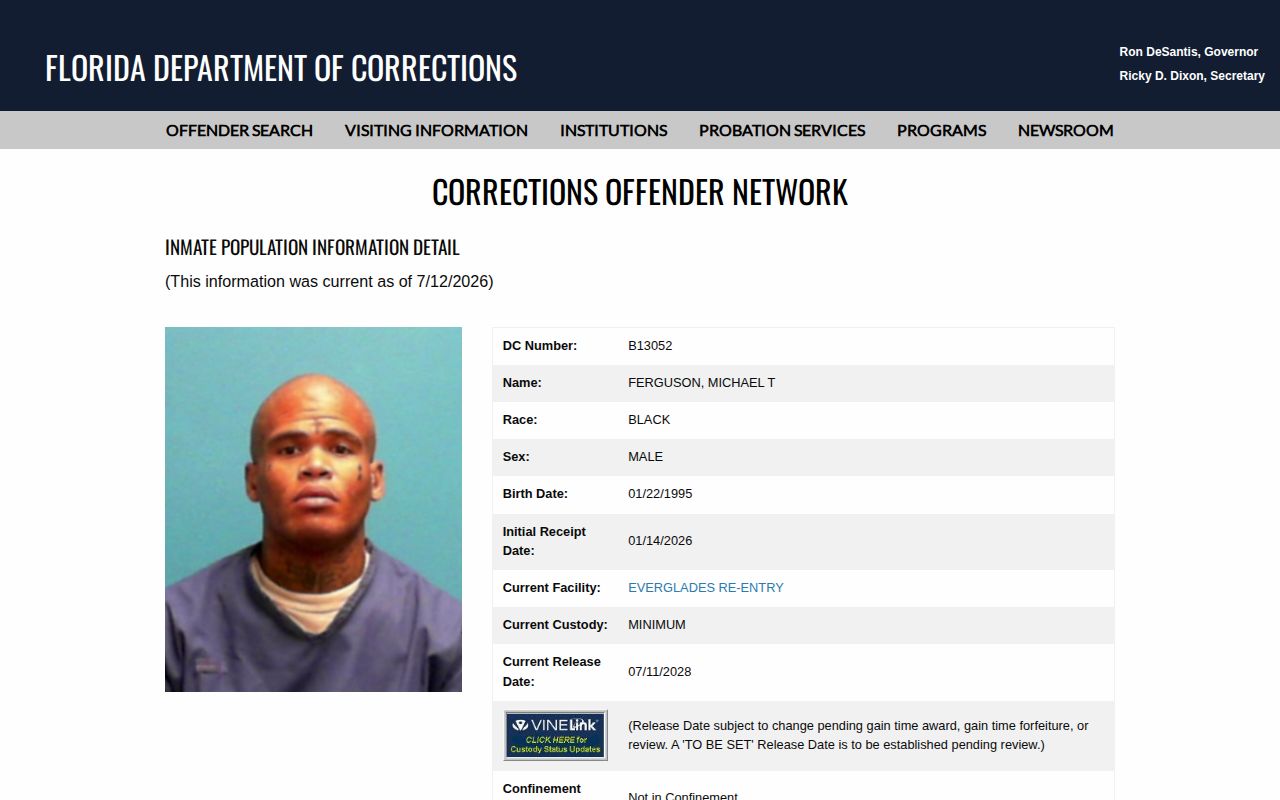
The example is useful for interface terms only. It should not be treated as a date for a different Escambia County person.
A full named-person custody search and release-record workflow is available on the Escambia County released-inmates home page.
Florida State Release Date Rules
Under Florida Statutes § 944.275, gain time that is granted or restored moves the tentative release date earlier in proportion to the award. Forfeited gain time moves it later. The tentative date cannot run beyond the maximum sentence expiration date. FDC also warns that the displayed Current Release Date can change because of awards, forfeitures, or review.
For eligible offenses committed on or after October 1, 1995, FDC may grant up to ten days per month of incentive gain time. Statutory exclusions apply. Section 944.275(4)(f) bars gain time from causing release before at least 85 percent of the imposed sentence has been served, with court-awarded credit for physical incarceration counting toward that floor. The Criminal Punishment Code provision reinforces the 85-percent principle.
Basic ten-day-per-month gain time is not a universal modern benefit. Subsection (6) limits that basic category to offenses from July 1, 1978 through December 31, 1993. Offense dates and eligibility matter. The statute screenshot shows the relevant tentative-date and gain-time provisions.
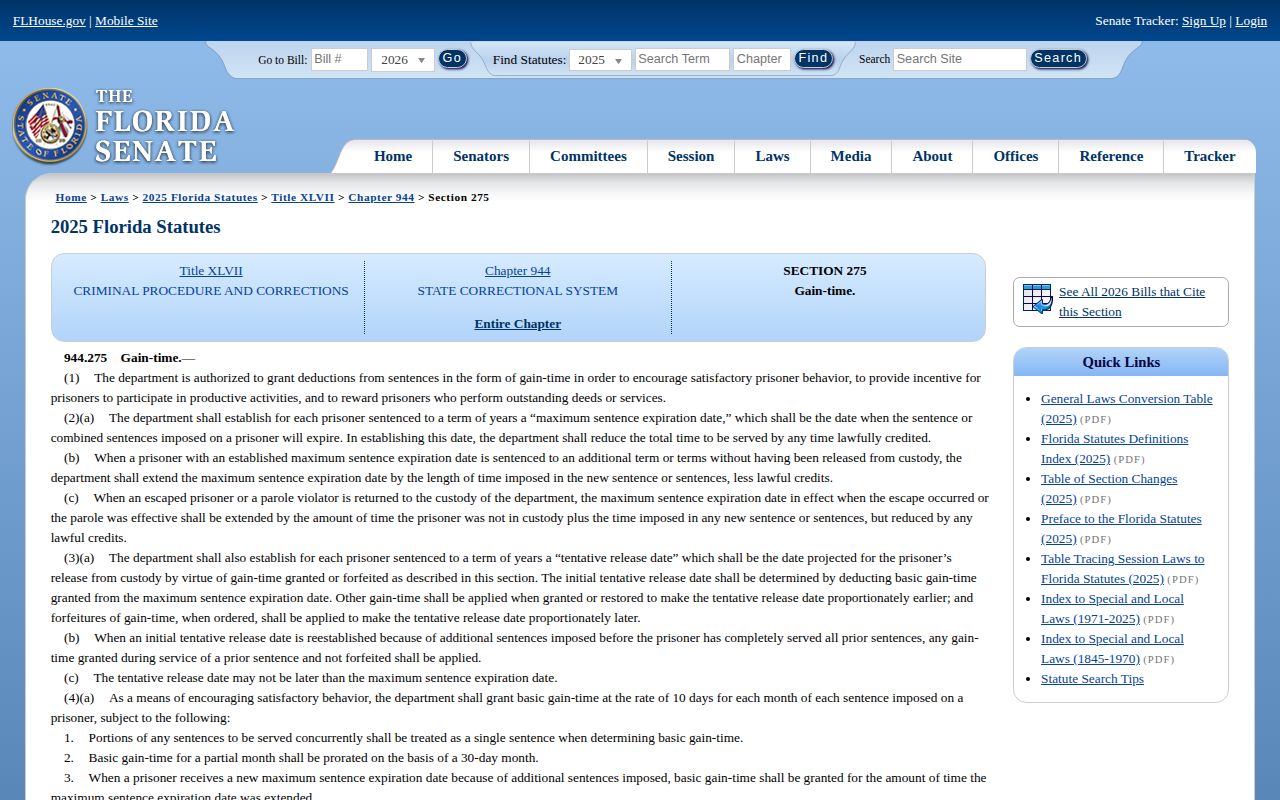
The statute supplies the legal framework, while FDC applies it to the sentence record and displays the operational date.
Escambia Dates Are Not Simple
Do not multiply a sentence by .85 and publish the result as a guaranteed day. The 85-percent floor is not a complete sentence calculation. Offense-date law, court-awarded jail credit, mandatory minimums, excluded offenses, concurrent or consecutive terms, later sentences, gain-time awards, forfeiture, restoration, and review can all change the result.
A detainer can also change what happens at the gate. A detainer is another agency's request to hold or receive the person. Arrival of the date may end one sentence yet lead to another jail, state custody, federal custody, or ICE instead of return to the community. Parole and conditional release can mean physical release with legal supervision still active.
Note: Use the agency's displayed date and ask the records office to resolve a discrepancy rather than reconstructing a sentence from public fragments.
Escambia County Jail Gain Time
Escambia's inmate handbook documents a local rule for eligible sentenced county prisoners. It states five statutory gain-time days for every 30 sentenced days, plus up to five additional days for each 30 consecutive days of satisfactory program or work participation. This county rule is the distinctive local calculation. It is not FDC's state-prison 85-percent framework.
Florida Statutes § 951.21 authorizes county policy and permits forfeiture. Court jail credit, local eligibility, discipline, and the actual adopted policy all affect the final county date. A person held before trial still lacks a sentence-based projection even though the same jail houses sentenced people.
| System | Forward-looking source | Key rule |
|---|---|---|
| Escambia pretrial | Court and bond orders | No fixed sentence date |
| Escambia county sentence | Corrections calculation and judgment | Local gain time and court credit |
| FDC state prison | Current Release Date | State gain-time law and applicable 85-percent floor |
| Federal prison | BOP sentence computation | Federal rules, not Florida gain time |
Read Escambia Release Date Records
The FDC search can accept the beginning of a first or last name, so a short name stem may return several people. A DC number is a stronger match. It has six characters and is either all numeric or one letter followed by five digits. Alias searching is optional, and a photograph may appear on the detail page. Compare those fields before reading any date as belonging to the person sought.
FDC separates its Inmate Population, Inmate Releases, Supervised Population, and Absconder/Fugitive databases. The release database includes people who have already left state prison as well as those scheduled for release, and FDC says it updates nightly. Population data are refreshed weekly except that release dates and locations update nightly. A changing Current Release Date can therefore appear on a different schedule from other identity or sentence fields.
County JAIL View uses a different identifier set. Its released result can display the booking number, MNI number, booking time, exact release time, charges, cases, holds, and a photo. It does not consistently show a legal release reason. The booking record answers when Escambia custody ended, while the judgment and release paperwork explain why and where the person went. Keeping those questions apart prevents a bond value or closed case from being mistaken for the actual release method.
Why Escambia Release Dates Change
A projection is a working result of a legal and administrative record. Some changes reward eligible conduct or correct credit. Others reflect discipline, a new order, or unresolved custody. The source of the change determines whom to contact.
| Factor | Possible effect | Verification source |
|---|---|---|
| Gain-time award or restoration | May move a tentative date earlier | FDC or Escambia sentence calculation |
| Gain-time forfeiture | May move the date later | Custodian's disciplinary and sentence record |
| Jail credit correction | Changes credited time | Judgment, court order, and records office |
| New or amended sentence | Can recalculate all terms | Clerk docket and commitment record |
| Consecutive sentence | Extends total custody | Judgment and FDC computation |
| Detainer or transfer | May end one custody but begin another | Release record and receiving agency |
| Pending review | May display “TO BE SET” | FDC Bureau of Admission and Release |
FDC's Inmate Release database updates nightly. For release-database questions, the Bureau of Admission and Release lists 850-488-9167 and dc.release@fdc.myflorida.com. Classification and Central Records lists 850-488-9859 for offender-data issues.
Confirm Escambia Actual Release
Once a projected day arrives, use an event record. FDC's dedicated Inmate Release Information Search covers people released or scheduled for release from state prison. A completed detail may show Release Date and incarceration-history Date Out-Custody. Those are stronger proof than an older projection.
For county custody, JAIL View pairs Status: Released with an exact timestamp under the booking number. If the record shows DOC, ICE, another county, or a federal hold, identify the receiving agency. For a pending alert rather than durable proof, Florida VINE can help. The VINELink release check explains record matching and notification registration.
A release date still does not prove that all legal control ended. Probation, conditional release, parole, a detainer, or transfer may follow. Read the supervision and receiving-custody systems before describing the person as free of custody or conditions.