
FPC Pensacola Federal Releases
Federal Prison Camp Pensacola is a minimum-security institution operated by BOP. Its commitment, sentence computation, transfer, and release records are federal. A past Escambia County booking may show that someone once moved into federal custody, but it cannot prove when BOP custody later ended.
The BOP locator may display “Released” or “Not in BOP Custody” with a release date. BOP warns that those labels mean only that the person is no longer in bureau custody. Another state, local, immigration, or federal process can still hold the person. A term of federal supervised release can also begin after prison.
Confirm FPC Pensacola Release
The BOP Inmate Locator covers federal inmates from 1982 forward. An identifier search is more precise than a name. It accepts a BOP Register, DCDC, FBI, or INS number. A name search can be refined by race, age, and sex, but each matching result still needs careful comparison.
- Open the official BOP Inmate Locator.
- Search by register number when known. Otherwise use the full name and available refiners.
- Match the name, register number, age, race, and sex.
- Read the release date and location or status exactly as displayed.
- If the result says Released or Not in BOP Custody, check the federal docket for the sentence and supervised-release term.
- Check another receiving system when a transfer or detainer is possible.
The official BOP Inmate Locator shows the federal fields and status warning.
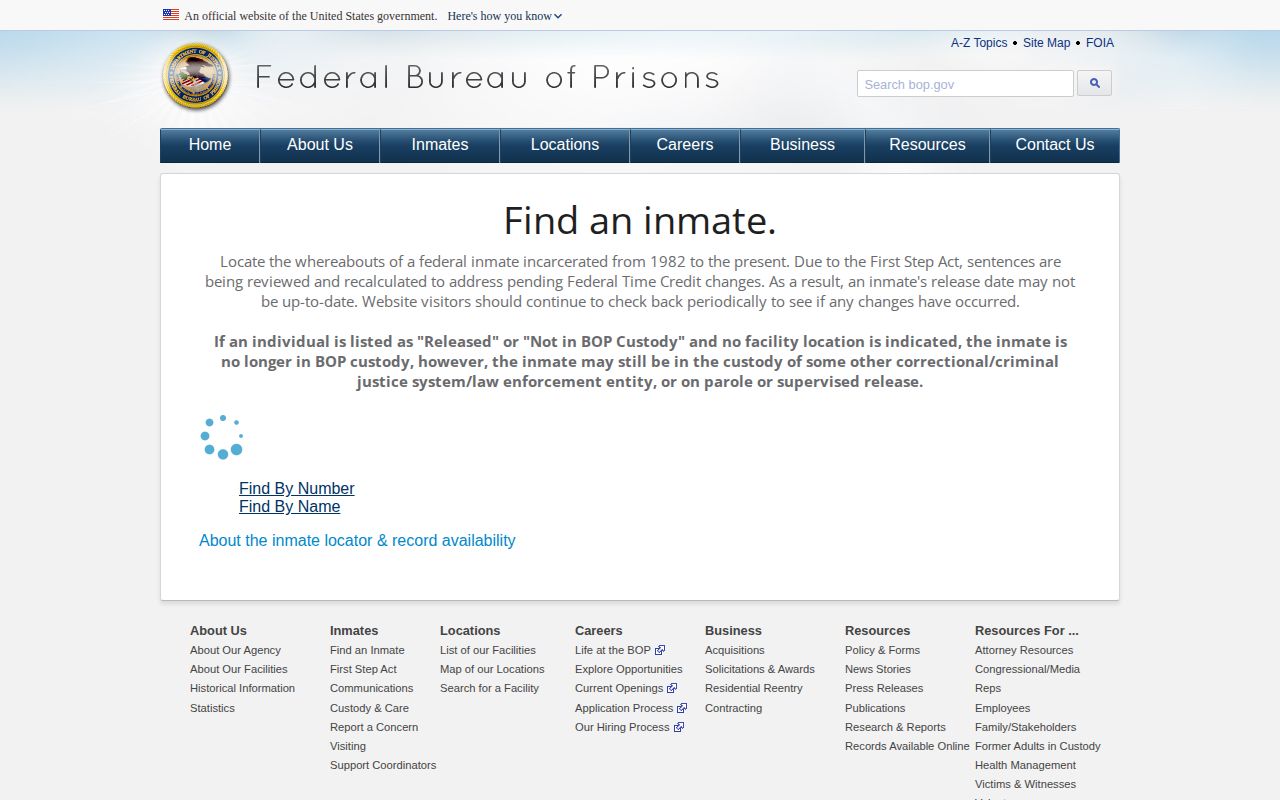
The locator is the public federal route. It does not report Florida probation and should not be replaced with FDC's state-prison release search.
The Escambia County release-search overview can help distinguish a federal result from county or state custody when the path is unclear.
Read FPC Pensacola Status
A BOP result table includes the person's name, register number, age, race, sex, release date, and location or status. A date in the future is an expected federal release date, not proof that departure occurred. BOP notes that First Step Act recalculation can change an expected date. The public result should be checked again after the date.
“Not in BOP Custody” can describe release, transfer outside bureau control, or a historical record without a current BOP facility. The release date and federal docket add context. A sentencing judgment can state the prison term and supervised-release term, while later docket entries can record revocation, modification, or other court action.
| Federal source | What it shows | Limit |
|---|---|---|
| BOP Inmate Locator | Release date and BOP status | Does not prove freedom from other custody |
| Federal judgment | Sentence and supervised-release term | May be changed by later orders |
| Federal docket | Case events and later court action | Not the physical exit timestamp |
| FPC Records Office | Commitment and sentence computation | Public access may require a records process |
| Receiving locator | Custody after BOP | Depends on the receiving sovereign |
FPC Pensacola Records and Contact
BOP facility material places FPC Pensacola on Saufley Field in Escambia County. The institution Records Office is responsible for legal commitments and release computations. Public historical confirmation usually begins with the BOP locator and the federal docket rather than a general call for private case details.
Federal Prison Camp Pensacola
110 Raby Avenue
Pensacola, FL
850-457-1911
Federal Bureau of Prisons
The official FPC Pensacola facility page is the source for the institution contact. Have the register number, full name, and specific release-computation question ready. The public office may restrict details that are not available for disclosure.
A federal records request should identify the exact computation or release record. The sentencing court is the better source for a certified judgment, and United States Probation handles post-release reporting under the federal court's order.
FPC Pensacola Is Not FDC
FPC Pensacola and Century Correctional Institution are both located in Escambia County, but they belong to different sovereigns. BOP uses federal register numbers and federal sentence rules. FDC uses six-character DC numbers and Florida gain-time law. Escambia County Corrections uses booking and MNI numbers for local jail records.
Do not apply Florida's 85-percent Criminal Punishment Code rule or FDC's Current Release Date label to a federal sentence. The BOP Records Office computes the federal term. Likewise, Florida parole and probation offices do not administer federal supervised release. That term belongs to the sentencing court and United States Probation.
- BOP custody
- Physical federal imprisonment administered by the Bureau of Prisons.
- Federal supervised release
- A court-ordered community term that normally follows imprisonment.
- Register number
- The BOP identifier used to distinguish federal inmates.
- Detainer
- A request from another authority to hold or receive a person after the current custody.
After an FPC Pensacola Release
The federal judgment usually states whether supervised release follows and for how long. A BOP release does not terminate that court term. Reporting instructions come from United States Probation, not FDC Circuit 1 or Escambia County pretrial services. A docket may later show modification or revocation.
A person can also leave BOP for another custodian. If a state or county detainer exists, search that agency's locator. Immigration custody uses ICE's Online Detainee Locator, which covers current custody and a short recent-release window rather than a permanent history. Absence from one receiving system does not prove unrestricted release.
For federal defendants held before sentencing, the United States Marshals Service has no general public locator equivalent to BOP and states that it does not release prisoner information to the public. The federal docket, counsel, or court contact is the proper presentence path. After BOP designation, use the BOP locator.
FPC Pensacola Release Dates
An expected date can change after sentence-credit review or federal recalculation. BOP specifically warns that First Step Act calculations can affect dates. The public locator is useful for the latest displayed result, while the institution Records Office handles the underlying legal commitment and computation.
A release date is not a release reason. It does not state that every charge ended, every detainer cleared, or federal supervision terminated. The federal judgment and later docket explain the legal sentence. A receiving locator explains a handoff. The BOP status proves only the bureau's part.
Note: Recheck the BOP locator after the expected date and pair its status with the federal docket before describing the completed release.
Request FPC Pensacola Release Records
When the public locator is not enough, request a specific federal record rather than asking for an entire file. Useful identifiers include the full name, register number, FPC Pensacola, sentence court, and approximate release date. Name the sentence computation, release record, or transfer information sought.
A certified judgment and sentence should come from the federal court. PACER or the court clerk provides the docket path. A computation question belongs to BOP. A supervised-release condition or revocation belongs to the court and United States Probation. Separating those custodians avoids sending a federal request to Escambia County or FDC.
Privacy and disclosure rules can limit what a third party receives. A no-result or withheld detail is not proof that no federal custody existed. Use the identifier, narrow the request, and ask the responsible office to identify the available record.
Match FPC Pensacola Records
Names alone are not enough. Federal records may include people with the same or similar names, and aliases can complicate the match. The register number is the best key. Compare age, race, sex, sentencing court, and known case information before associating a release date with a person.
FPC Pensacola's minimum-security label also does not describe the legal result. Security level concerns facility operation, not guilt, sentence completion, or supervision. Keep the record focused on the BOP custody event and the court's orders.
Note: A federal release search should remain within BOP and court records unless a verified receiving agency creates a separate custody trail.