
Escambia Parole and Probation Types
Florida does not use parole as a broad name for every person monitored after release. The Florida Department of Corrections, or FDC, provides field supervision for probation, community control, parole, conditional release, and other forms ordered by a court or the Florida Commission on Offender Review. FCOR makes decisions in the limited cases that remain parole eligible. The sentencing court orders probation. Each label has a different legal source, so the exact label in the state record matters.
Modern felony sentences usually are not parole sentences. Florida's Criminal Punishment Code statute says chapter 947 parole does not apply to people sentenced under that Code. Older cases and narrow offense groups can still qualify. Conditional release is also not parole. It is a mandatory post-prison supervision mechanism for qualifying cases, while parole is discretionary.
| Supervision | Who orders it | What the record means |
|---|---|---|
| Probation | Sentencing court | The person serves court-set conditions in the community, often instead of or after jail. |
| Community control | Sentencing court | A more restrictive form of community supervision with close monitoring. |
| Parole | FCOR | A discretionary release process that now applies mainly to older or exceptional cases. |
| Conditional release | FCOR under statute | Mandatory supervision after prison for a qualifying sentence, subject to revocation. |
| Pretrial release | Escambia court | Monitoring while charges remain pending, not a sentence or state probation. |
- Discharge
- The formal end of a custody or supervision term.
- Absconder
- A person who stopped making themselves available to FDC supervision.
- Revocation
- An order ending community placement and potentially returning a person to custody.
- PPRD
- A Presumptive Parole Release Date considered in an eligible parole case.
Check Escambia Post-Release Supervision
The official starting point is FDC's Supervised Population Information Search. It covers state felony supervision, not a person whose only obligation is Escambia County pretrial release or a federal supervised-release term. A six-character DC number is the strongest key. A name search can also work, but similar names require a photo and identity comparison.
- Search by DC number when known. Otherwise, enter the full first and last name.
- Open the matching detail and compare the photograph, identity fields, and case information.
- Read the supervision type, start date, termination information, and supervising office shown.
- If an expected active record is missing, check FDC's Absconder/Fugitive Search.
- Compare probation with the Escambia Clerk criminal docket. For parole or conditional release, use FCOR's status and records channels.
FDC reports that supervised-population data are refreshed weekly, while termination dates and locations update nightly. That cadence can explain a brief mismatch. The jail release timestamp and the state supervision record prove different events. One shows departure from jail; the other shows continuing legal control.
The FDC database menu shows the separate release, supervised, and absconder systems.
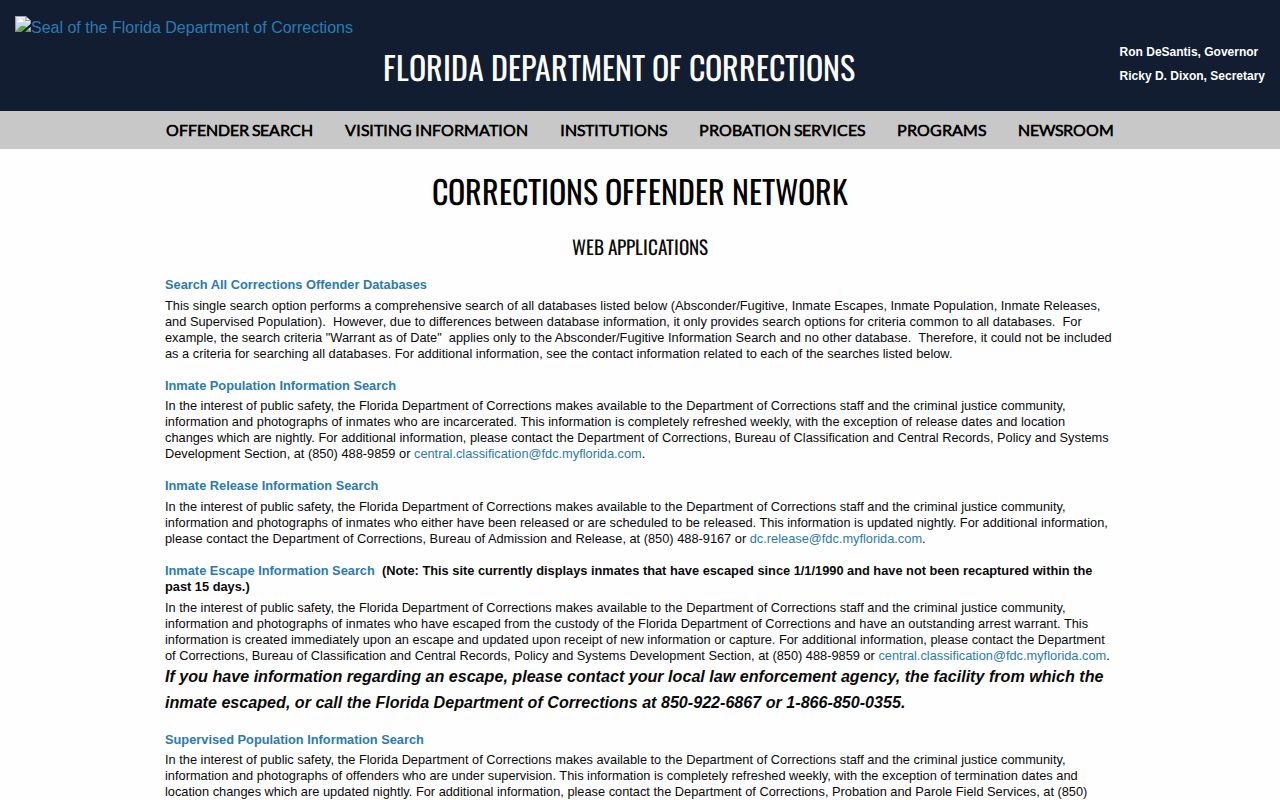
The menu helps keep an inmate release record separate from an active community-supervision or absconder record.
For the full custody and release-record path, the Escambia County released-inmate search explains how JAIL View, the court docket, and receiving systems fit together.
Escambia Probation Office Contacts
Escambia County is in FDC Circuit 1. The office shown on a person's current detail is the best contact because assignments can differ across Pensacola. An office may confirm reporting instructions with the supervised person while limiting what it discloses to someone else. Do not assume that every Escambia record reports to the same building.
010 Pensacola Circuit
2108 Douglas Avenue
Pensacola, FL 32504
850-595-8953
pensacola.cir@fdc.myflorida.com
015 Pensacola West/Intake
3100 W. Fairfield Drive
Pensacola, FL
850-595-8900
016 Pensacola Main
9211 N. Davis Highway
Pensacola, FL
850-595-8845
The official Pensacola Circuit office list provides the local entries.
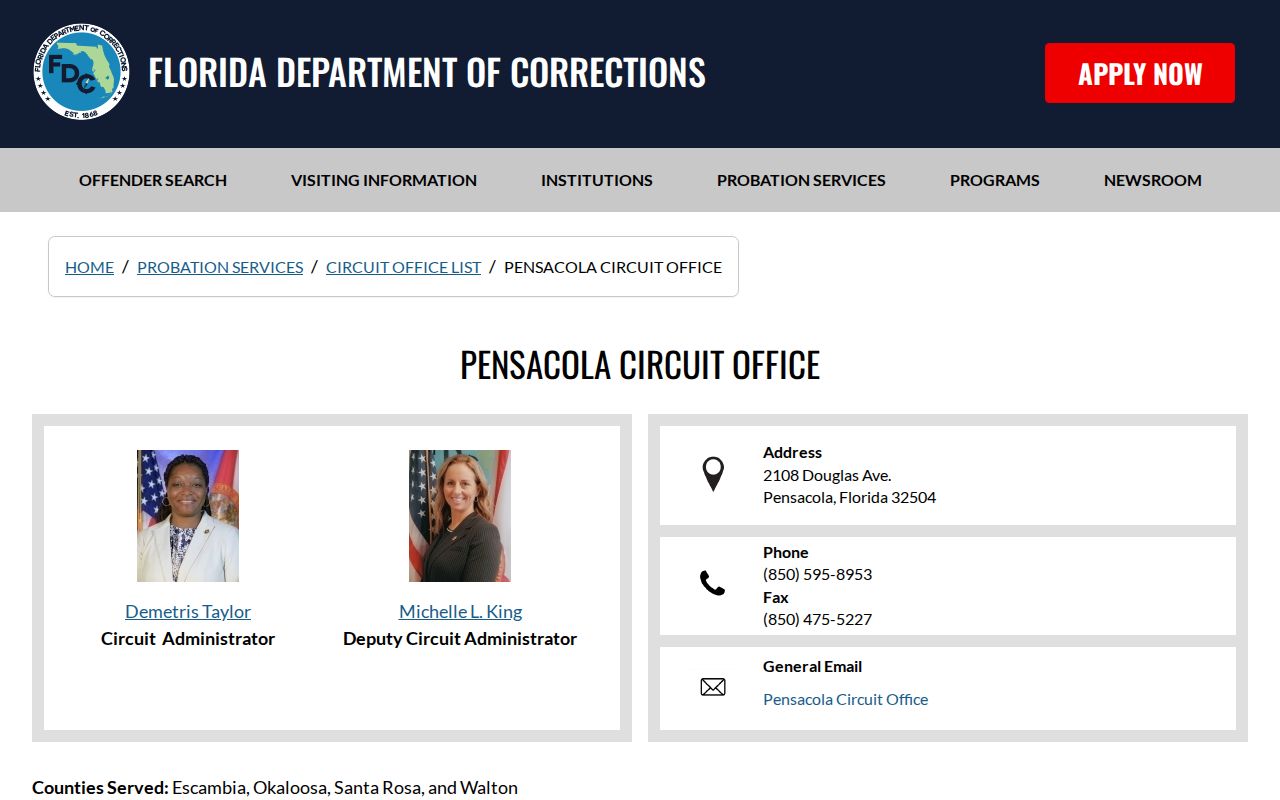
Use the displayed office from the individual FDC record to choose among these Circuit 1 contacts.
For general field services, FDC lists Probation and Parole Field Services at 850-717-3444 and co-supervision@fdc.myflorida.com. Those contacts address state supervision, not county pretrial reporting.
Escambia Pretrial Is Not Probation
Escambia Community Corrections runs Pre-Trial Release for people referred by a judge while charges are pending. Jail staff complete the paperwork, provide the conditions, and the participant ordinarily reports each week until completion, revocation, or removal by the court. Cash or surety bond can exist alongside this local monitoring. Physical release on bond does not mean the criminal case or court control ended.
The Escambia Pre-Trial Release program lists 6400 N. W Street in Pensacola and 850-595-3100. The county says the program itself charges no supervision fee, although ordered testing can carry stated fees. That local office should not be substituted for FDC when a judgment imposes probation.
Note: Read the court order and the actual agency label before calling a community condition parole, probation, or pretrial release.
Escambia Absconder and Violation Records
An absent supervised-population result does not prove that supervision ended. Search FDC's Absconder/Fugitive database when a person was expected to report but no longer appears active. Absconder means the person ceased making themselves available to supervision. It does not undo the earlier jail or prison release.
The absconder system uses the same weekly full refresh and nightly location or termination updates described by FDC. The Absconder Unit is listed at 850-717-3475 on weekdays from 8:00 a.m. to 5:00 p.m. A warrant, violation report, or revocation can return someone to custody, but only the current official record or court action confirms that change.
The official absconder search form shows the separate lookup.
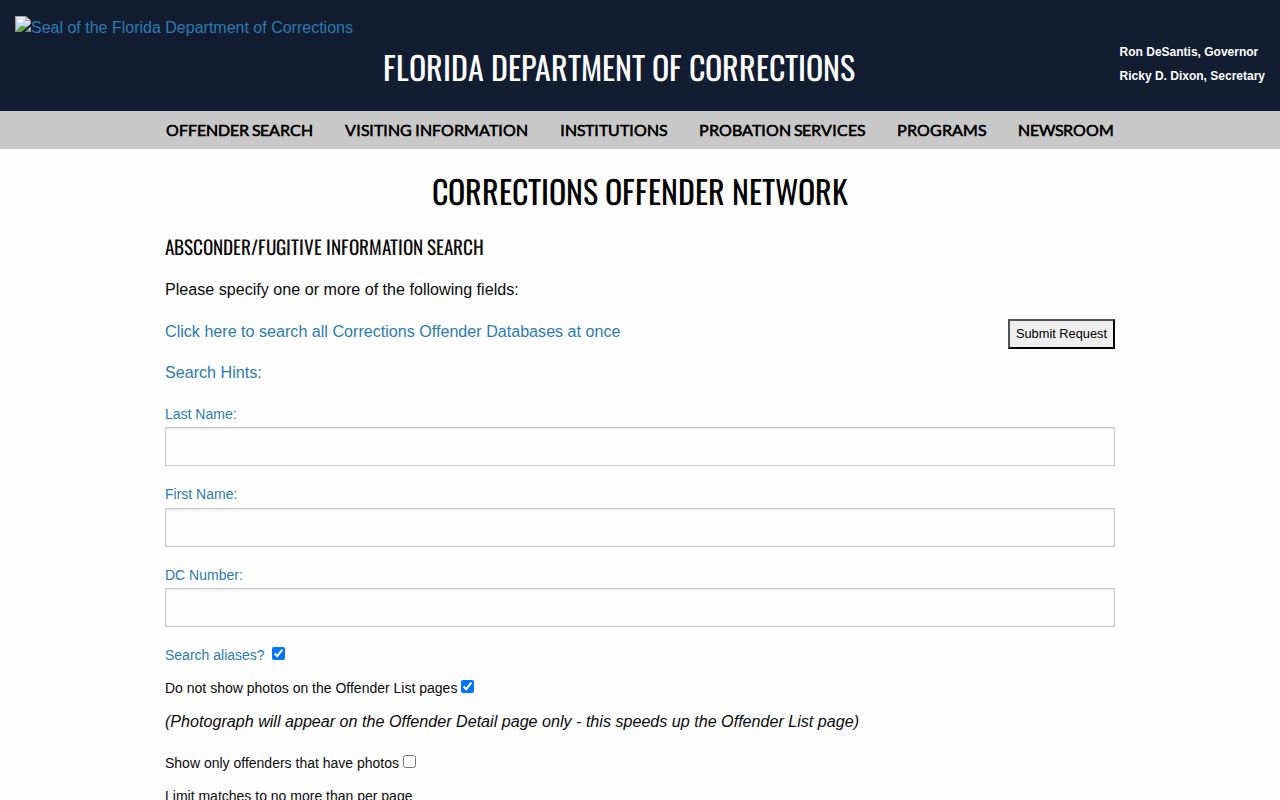
This form is a fallback for state supervision, not a substitute for the Escambia jail's booking and release record.
Escambia Parole Hearing Records
FCOR publishes a rolling Commission Voting Schedule with several voting and teleconference dates in many months. It does not promise one fixed weekly cadence. A dated agenda can list the name, DC number, interview category, panel or full commission, county, offense, and case number. The researched calendar included an Escambia parole matter, which shows why the statewide process can be locally relevant.
The agenda is not a decision database. No searchable historical post-vote results system was found in FCOR's public calendar, agenda, hearing guide, reports, or records pages. For individual status, FCOR lists 1-800-335-3396. A supporter may ask for notice of the decision. Written actions or orders may be requested from FCOR Public Records at fcorlegal@fcor.state.fl.us or 850-848-4460.
The FCOR voting schedule is the official calendar.
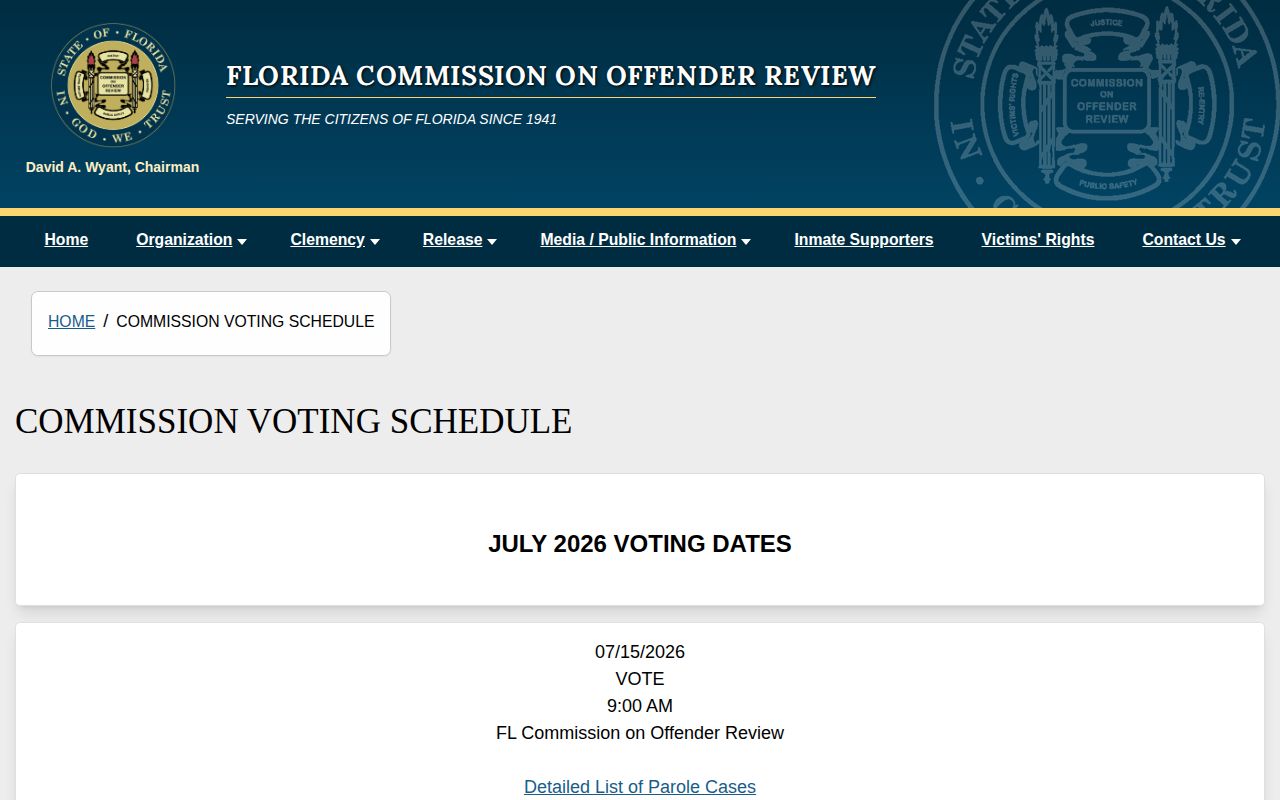
The calendar proves a matter is scheduled, while a case-status response or written order proves what FCOR decided.
Escambia Post-Release Reentry Contacts
Local navigation does not replace an FDC reporting instruction. It can still help a person meet practical needs after release. Re-Entry Alliance Pensacola, or REAP, is at 1000 W. Blount Street, Pensacola, with 850-332-6677 and inquiries@reapreentry.org. REAP, Pathways for Change, and programs associated with the county Work Annex are local points to ask about current services.
Eligibility, space, and intake can change. Contact each program before relying on it. The Work Annex program page identifies local vocational, education, recovery, farming, and life-skills programming, but participation in custody is not a promise of a service after discharge.
Escambia Release Property and Funds
Escambia's inmate handbook describes a practical distinction between community discharge and transfer. Clothing is generally retained so a person has clothes at jail release. Accrued account debt is deducted first, and the balance is issued on a prepaid debit card. When a receiving facility cannot use that card, the county issues a check instead.
Those details do not prove that supervision ended. They help interpret the physical handoff. A debit card and returned clothes fit a community discharge, while a check for an incompatible receiving facility can accompany transfer. The supervision answer still comes from FDC, FCOR, or the court record.
Note: Release property and funds describe jail processing, while discharge or termination fields describe the end of legal supervision.